See if a Wealth
Clarity Chat is
right for you.

The QSBS Advantage: How to Turn Startup Equity into Tax-Free Wealth

A businessman in a suit stands by a large window overlooking a city skyline with skyscrapers and a bright sky.

TL;DR Answer Box

Qualified Small Business Stock (QSBS) is a special tax rule under IRC Section 1202 that can let eligible investors and employees exclude up to $10M in federal capital gains (or 10x your cost basis, whichever is greater) if they acquire shares directly from a qualifying U.S. C-corp and hold them for at least five years. It’s powerful, but strict. Company eligibility (industry exclusions + $50M gross asset cap), how you acquired the stock (must be original issuance), the five-year clock, AMT/NIIT considerations, and state tax conformity can make or break the outcome. If you need liquidity before five years, Section 1045 may allow a rollover into new QSBS within 60 days to defer the gain.

Last updated: February 10, 2026

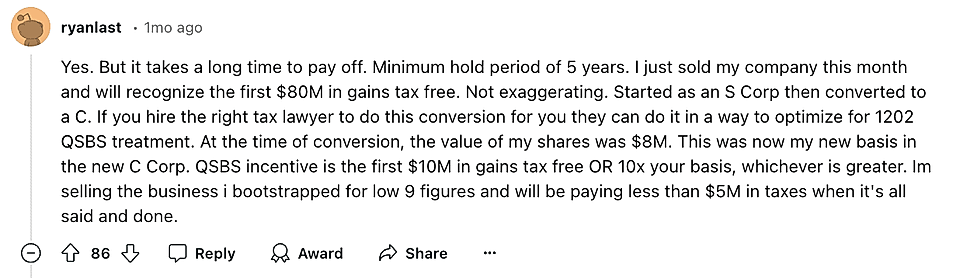
Comment from user ryanlast discussing tax benefits of C Corp conversion and QSBS treatment after selling a business.

Introduction

Imagine a world where you can invest in a promising startup, hold your shares for a few years, and then sell, while keeping a significant chunk (and potentially all) of your gains out of the taxman’s reach.

That’s the dream behind Qualified Small Business Stock (QSBS). If you meet the rules under Internal Revenue Code Section 1202, QSBS can unlock some of the most attractive capital gains treatment available to high earners.

But QSBS isn’t “free money.” It’s a high-upside tax strategy wrapped in fine print: entity type rules, industry exclusions, acquisition rules, asset caps, holding period requirements, and state-level gotchas.

What Is QSBS (Section 1202)?

Qualified Small Business Stock (QSBS) refers to shares issued by a qualified small business that meets specific requirements under IRC Section 1202.

Baseline QSBS Eligibility Requirements

  • Domestic C-corporation: The company must be a U.S. C-corp (not an LLC taxed as a partnership, not an S-corp).
  • Active trade or business: The business must be operating (not primarily holding investments).
  • Industry exclusions apply: Many service businesses (e.g., law, health, finance), banking, farming, hospitality, and other excluded categories generally do not qualify.
  • $50M gross asset test: The company’s gross assets must not exceed $50 million when the stock is issued and immediately after issuance.
  • Original issuance requirement: You must acquire the stock directly from the company (purchase, exchange, or compensation for services). Stock bought on a secondary market usually does not qualify.
  • Five-year holding period: To claim the full Section 1202 exclusion, you generally must hold the shares for at least five years.

Welcome to QSBS: The Two Ways You’ll Usually Get It

Most people encounter QSBS in one of two ways:

  • Employee compensation: Startups and growth-stage companies use equity as “in-kind” compensation when cash is tight and to align incentives.
  • Direct investment: Angels, founders, and early investors purchase original-issue shares as the company raises capital.

The Big Prize: Excluding Up to $10M (or 10x Basis)

The basic Section 1202 benefit allows eligible holders to exclude up to $10 million of federal capital gains per issuer (subject to rules and limitations).

For certain investors, the benefit can be even more substantial because the exclusion is capped at the greater of:

  • $10,000,000, or
  • 10x the adjusted basis of the QSBS investment

Example: If you invested $10M at original issuance and later sell for a massive gain, the “10x basis” framework can create a potential exclusion up to $100M (subject to all eligibility rules being met).

The Considerations and Limitations of QSBS

1) Exclusion Percentage Depends on When You Acquired the Stock

QSBS offers a tiered exclusion rate based on acquisition date:

  • 100% exclusion for QSBS acquired after September 27, 2010 (subject to the $10M/10x basis cap).
  • 75% exclusion for QSBS acquired between February 17, 2009 and September 27, 2010.
  • 50% exclusion for QSBS acquired before February 17, 2009.

2) QSBS Is Federal, States Can Disagree

QSBS is rooted in U.S. federal tax law, so it applies at the federal level. But states don’t have to follow it.

Some states do not conform to federal QSBS treatment, meaning you might still owe state capital gains taxes even if your federal tax is reduced or eliminated.

As of writing, residents in Alabama, California, Mississippi, New Jersey, Pennsylvania, and Puerto Rico generally aren’t eligible for QSBS exclusion at the state level. Hawaii and Massachusetts partially conform.

Bottom line: your after-tax QSBS outcome can vary dramatically based on residency and filing situation.

3) AMT, NIIT, and Other Taxes Can Still Matter

Even if you qualify for the Section 1202 exclusion, additional layers may still apply depending on your situation (including Alternative Minimum Tax considerations in certain cases, and the Net Investment Income Tax in other contexts).

This is one reason QSBS planning should be modeled, not guessed.

The Art of Rolling Over: Section 1045

The five-year holding period is a big deal. Startups can change fast, and sometimes liquidity shows up before the clock runs out.

IRC Section 1045 provides a valuable “escape hatch” that may allow you to defer capital gains if you sell QSBS before the five-year holding period, by rolling the proceeds into new QSBS.

Section 1045: The Core Rule

  • You must reinvest proceeds into another qualifying QSBS within 60 days of the sale.
  • The original shares must have been acquired at original issuance (purchase, exchange, or compensation).
  • This rollover is generally available to individuals, partnerships, and certain trusts (but not corporations).

This doesn’t erase tax, it typically defers it until the subsequent QSBS is sold (unless a later Section 1202 exclusion applies after meeting the relevant rules).

QSBS Liquidity: How You Might Actually Sell

Liquidity doesn’t only come from IPOs. Common liquidity routes include:

  • Acquisition: your shares are sold as part of a company sale.
  • Tender offers: company-facilitated share buybacks for employees/investors.
  • Secondary sales: selling shares privately or on a secondary platform (note: buyers typically don’t get QSBS since they didn’t acquire at original issuance).
  • IPO + public sale: selling shares on the open market after going public (QSBS exclusion can still apply if rules are satisfied).

QSBS in Action: A Simple Example

Emma is a single filer with $450,000 of ordinary taxable income, putting her in the top federal long-term capital gains bracket (20%).

Emma makes an angel investment in a tech startup that qualifies for QSBS. She purchases shares on October 1, 2017. By October 1, 2023, her shares have appreciated significantly.

Emma sells and realizes a gain of $100,000.

Because she held the shares for more than five years and acquired them after September 27, 2010, she can exclude 100% of that gain under QSBS rules (assuming all other requirements are met). Instead of paying federal long-term capital gains tax (and potentially NIIT), her federal tax on that gain could be $0.

If She Sold Before Five Years

If Emma sold after four years, she would generally fail the five-year holding requirement for Section 1202. But if she reinvested the proceeds into new QSBS within 60 days, Section 1045 may allow her to defer the gain and continue the strategy.

Making Cents of Qualified Small Business Stock

So, is QSBS worth it?

Absolutely, if you can navigate the rules and you’re willing (and able) to commit to the five-year hold. All else equal, QSBS is more advantageous than ordinary stock because it can materially improve your after-tax outcome.

The tradeoff is complexity. Eligibility can be lost, documentation can be incomplete, and state taxes can blunt the headline “0%” benefit.

If you’re receiving startup equity as compensation or investing meaningful capital, QSBS should be part of your planning conversation early, before liquidity shows up and you’re stuck reacting.

Key Takeaways

  • QSBS can exclude up to $10M (or 10x basis) of federal capital gains if Section 1202 rules are satisfied.
  • Five years is the price of admission for the full exclusion, plan liquidity accordingly.
  • Original issuance matters: secondary purchases typically don’t qualify for QSBS benefits.
  • State taxes can reduce the benefit because some states do not conform to QSBS rules.
  • Section 1045 can defer gains if you sell early and reinvest in new QSBS within 60 days.

FAQ

Is QSBS only for venture capitalists?

No. Employees receiving equity compensation and angel investors can also benefit, if the company and shares qualify and you meet the holding period requirements.

Do I need an IPO to use QSBS?

No. QSBS gains can be realized via acquisitions, tender offers, and other liquidity events. IPOs are just one path.

If I buy shares from someone else, do they qualify as QSBS for me?

Usually not. QSBS generally requires acquiring shares at original issuance directly from the company. Buying on the secondary market typically breaks eligibility for the buyer.

What if I need liquidity before five years?

You may be able to use Section 1045 to defer the gain by rolling proceeds into new QSBS within 60 days, assuming the rules are met.

Does QSBS eliminate state taxes too?

Not necessarily. Some states don’t conform to federal QSBS rules, meaning you could still owe state capital gains taxes even if federal tax is reduced.

CTA

If you’re receiving startup equity or investing in private companies, QSBS planning is one of those “measure twice, cut once” areas. The upside is massive, but the rules are strict. If you want help pressure-testing eligibility, documenting the right items, and modeling liquidity scenarios, talk with a tax professional and a planner who has direct QSBS experience.

Disclaimer

The information provided is for educational and informational purposes only and does not constitute investment advice and it should not be relied on as such. It should not be considered a solicitation to buy or an offer to sell a security. It does not take into account any investor's particular investment objectives, strategies, tax status or investment horizon. 

No investment strategy or risk management technique can guarantee returns or eliminate risk in any market environment. All investments include a risk of loss that clients should be prepared to bear. The principal risks of Tailored Wealth’s strategies are disclosed in the publicly available Form ADV Part 2A.

The views expressed in this commentary are subject to change based on market and other conditions. These documents may contain certain statements that may be deemed forward looking statements. Please note that any such statements are not guarantees of any future performance and actual results or developments may differ materially from those projected. Any projections, market outlooks, or estimates are based upon certain assumptions and should not be construed as indicative of actual events that will occur.

All information has been obtained from sources believed to be reliable, but its accuracy is not guaranteed. There is no representation or warranty as to the current accuracy, reliability, or completeness of, nor liability for, decisions based on such information and it should not be relied on as such.

Tailored Wealth and its advisors do not provide legal, accounting, or tax advice. Consult your attorney or tax professional. 

This content is for educational purposes only and is not tax, legal, or investment advice. Tax and retirement rules vary by state and change over time. Consult your professional advisors regarding your specific situation.