See if a Wealth
Clarity Chat is
right for you.

Are Your RMDs the Problem, or Is It How You Sequence Your Withdrawals?

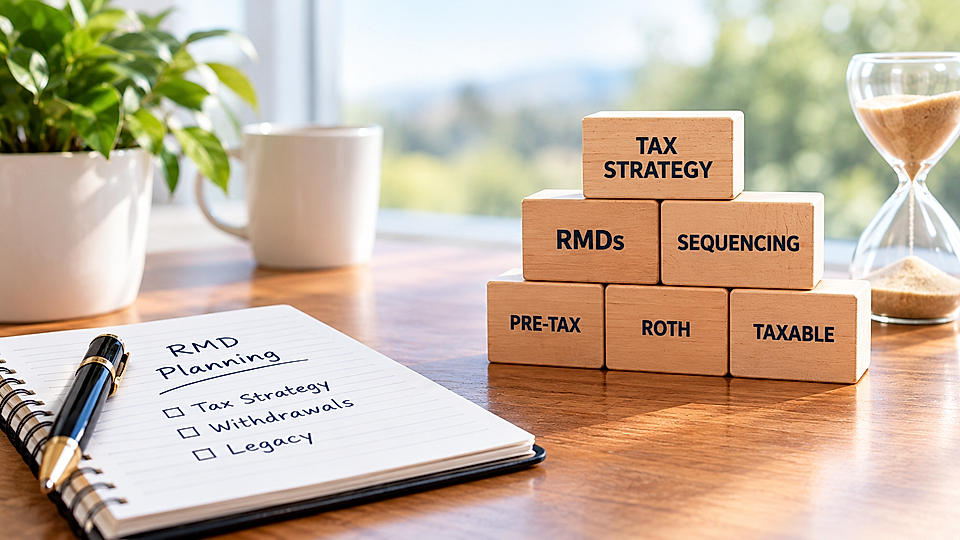
RMD planning notes with stacked tax strategy blocks on a desk

TL;DR

Once your pre-tax accounts cross the $5 to $7 million range, "don't worry about RMDs" advice stops applying. RMDs at this level aren't really a tax-bill problem. They're a sequencing problem.

  • The new senior deduction phases out at $150,000 of income for a couple ($75,000 single), well below what a large RMD produces on its own.
  • A required minimum distribution on a $7 million balance can run roughly $285,000 in year one, pressing straight through the 32% bracket.
  • If one spouse later files alone, the same tax bracket roughly halves. We call this the survivor's tax problem.

Why "Don't Worry About RMDs" Falls Apart Above Seven Figures

Every retirement channel on YouTube seems to have landed on the same message lately: stop worrying about your RMDs. The reasons sound good. There's a bigger standard deduction, a new senior tax break, and a later starting age for required withdrawals. For most retirees, that reassurance is right.
The deduction everyone is excited about is real. If you're 65 or older, you can take up to $6,000 per person on top of the standard deduction, through 2028. Here's the part that rarely gets mentioned: that bonus starts phasing out at $150,000 of income for married couples and $75,000 for single filers. If you spent your career maximizing equity comp, deferring income, and building a seven-figure retirement account, your retirement income is unlikely to sit below those lines. The tax break making everyone else feel better about RMDs probably doesn't apply to you. That isn't a reason to panic, it's a reason to stop relying on generic advice. Several of the newer tax benefits carry phaseouts and expiration dates, which we covered in our high earner tax playbook.
Here's the actual math. For a married couple, the 32% bracket starts just over $400,000 of taxable income in 2026. Required distributions begin at 73 or 75, depending on your birth year. Consider a couple with $7 million in pre-tax accounts at 75. Their first RMD is roughly $285,000. Stack Social Security, dividends from a taxable account, and any consulting income on top, and they're pressing against the 32% bracket in year one. The required percentage rises every year after that. The RMD doesn't nudge your bracket. Over time, it can push straight through it.

Prefer to watch this one? Dan broke down this exact topic on video:

The Real Question Isn't Whether You'll Owe Tax, It's the Order You Draw Money In

If a large RMD isn't really about whether you'll have income, and the new deductions mostly don't reach you, what should you actually be solving for? Which accounts you draw from, in which years, and in what order, starting years before your first required withdrawal. That's a sequencing decision, not a single tax-return decision, and it's the piece that a lot of "don't worry about RMDs" content skips entirely.

The Survivor's Tax Problem

This is the one that catches people off guard, even when they've done careful planning. While you're married, your household shares one set of brackets built for two people. If one spouse passes away, the surviving spouse keeps most of the assets, much of the Social Security income, and an RMD calculated the same way. But the tax brackets get cut roughly in half.
That 32% bracket starting around $400,000 for a couple starts around $200,000 for a single filer. An RMD you absorb comfortably as a couple can push a surviving spouse into a materially higher bracket on the same withdrawal. We call this the survivor's tax problem. It's why we don't just plan for this year's return. We plan for what the return looks like if one of you is filing alone.

What Most People Miss: The Medical Deduction Case for Keeping Pre-Tax Money

If you've been aggressive with Roth conversions to get ahead of RMDs, there's a version of that strategy that can cost you later. It involves your health.
The IRS allows a deduction for medical expenses that exceed 7.5% of your adjusted gross income. In working years, that threshold is hard to clear. Later in retirement, many people face an expense that clears it easily: moving into a continuing care retirement community. These communities often require an upfront entrance fee of several hundred thousand dollars in exchange for guaranteed care as your needs change. A meaningful portion of that fee typically qualifies as a deductible medical expense in the year you pay it.
So in the year you move in, you can pull a lump sum from your traditional IRA to cover the fee. The withdrawal creates a spike in taxable income, but the medical portion of the fee can offset a large share of it. You get cash out of a pre-tax account at a low tax cost, in exactly the year you need it most. The same logic can apply to significant out-of-pocket long-term care costs.
Now imagine you had already converted everything to Roth in your 60s, paying 24% or more along the way. You'd have used after-tax dollars to fund that bill, and the medical deduction would go largely to waste.

Build Three Buckets, Not One

That's why we rarely tell clients to go all Roth or all pre-tax. We build toward meaningful balances in three places: pre-tax, Roth, and taxable. If tax rates rise, you lean on the Roth. A lower income year becomes a conversion opportunity. A large medical or long-term care expense is when pre-tax dollars come out with the least friction.
This is the same three-bucket tax structure we use after liquidity events, and it becomes more valuable the closer you get to RMD age. The years between leaving full-time work and your first required withdrawal are often the best window to shape those balances, a point Dan covered in this video on when high earners can actually retire.

Two Tools That Shrink the RMD Math

The first is a Qualified Longevity Annuity Contract, or QLAC. You can move up to $210,000 per person from your IRA into a QLAC, and that balance is excluded from your RMD calculation until payments begin. For a couple, that's up to $420,000 removed from the math.
The second is the Qualified Charitable Distribution, or QCD. Once you're 70½, sending money directly from your IRA to a charity satisfies part of your RMD without counting as taxable income, up to $111,000 per person in 2026. If giving is already part of your plan, QCDs can help you stay below a Medicare surcharge threshold or keep a high income year from pushing you further up the brackets than necessary. For a closer look at how these two tools fit together with a full RMD plan, see our RMD strategies for high earners breakdown.

A Worked Example: Paul and Denise's Sequencing Plan

Take Paul and Denise (not their real names), both 74, two years from their first required withdrawal. Paul spent three decades in corporate leadership and built a combined $7.1 million across a 401(k) and rollover IRA. Their projected first RMD, once it starts, is roughly $285,000, which lands them at the edge of the 32% bracket the moment Social Security and dividend income are added on top.
Instead of waiting for the RMD to arrive and reacting to it, here's the sequencing plan we built with them. Move $210,000 each into a QLAC, removing $420,000 from the RMD calculation entirely and locking in guaranteed income for later in life. Direct a portion of future RMDs as QCDs to the causes they already support, satisfying part of the requirement without adding to taxable income. And instead of converting the rest of the balance to Roth on an aggressive schedule, keep a meaningful pre-tax cushion in case either of them needs a continuing care community or meaningful long-term care later, so a real medical deduction has pre-tax dollars to offset instead of wasted after-tax Roth money.
The result isn't a lower RMD next year. It's a plan for which account pays for what, in which year, no matter which version of retirement Paul and Denise end up living.

Who This Is For

This is written for executives and retirees with $5 million or more concentrated in pre-tax retirement accounts, typically built through decades of maximized 401(k), deferred comp, or equity compensation, who are approaching or already past required minimum distribution age. If you've heard the "don't worry about RMDs" message, want to believe it, and suspect your numbers might tell a different story, this is the exact problem we solve.
Having too much in pre-tax accounts in your 70s is a good problem. It's still a problem worth solving early. At Tailored Wealth, this is the planning work we do every day. We project your RMDs years in advance, model both the married and survivor tax scenarios, and map when Roth conversions make sense and when keeping pre-tax dollars is the smarter move. That sequencing becomes part of a tax-aware withdrawal plan tied to your Life Driven Investing structure, so the right money is available in the right year, and we revisit it every quarter as tax law, markets, and your life change.

Frequently asked questions

What does it mean to call RMDs a sequencing problem instead of a tax problem?

It means the real decision isn't whether you'll owe tax on a required withdrawal, it's which accounts you draw from and in what order in the years before your first RMD. Once your pre-tax balance is large enough to push through the top brackets on its own, the planning shifts from managing this year's tax bill to shaping which account pays for what over the next decade.

Why doesn't the new senior tax deduction offset a large RMD?

The deduction is worth up to $6,000 per person through 2028, but it phases out starting at $150,000 of income for a married couple and $75,000 for a single filer. A required minimum distribution on a multi-million-dollar pre-tax balance typically pushes household income well past those lines before the deduction can do much work.

What is the survivor's tax problem and why does it matter for couples with large IRAs?

It's what happens when one spouse passes away: the household's assets, Social Security income, and RMD calculation stay roughly the same, but the tax brackets get cut in half because the survivor now files as a single person. An RMD a couple absorbs comfortably at 32% can push a surviving spouse into that same bracket, or higher, on the identical withdrawal.

How much can a QLAC remove from my RMD calculation?

Up to $210,000 per person, or $420,000 for a couple, moved from an IRA into a qualified longevity annuity contract. That amount is excluded from the RMD calculation until the contract's payments begin, which shrinks required distributions during the years the money sits inside it.

How does a qualified charitable distribution work with my RMD?

Once you're 70½, you can send up to $111,000 per person directly from your IRA to a qualified charity in 2026. That gift counts toward satisfying your RMD for the year without ever showing up as taxable income, which can help keep a high-income year from pushing further into a higher bracket or past a Medicare surcharge threshold.

Can moving into a continuing care retirement community actually reduce my RMD tax bill?

Often, yes. A meaningful portion of a CCRC's upfront entrance fee typically qualifies as a deductible medical expense once your total medical costs exceed 7.5% of adjusted gross income, which is realistic for many retirees. Pulling a lump sum from a traditional IRA in the year you move in can let that medical deduction offset much of the taxable income the withdrawal creates, which is one more reason to keep meaningful money in pre-tax accounts rather than converting everything to Roth early.

If you want to see what this looks like with your own account balances and timeline, book a Free Wealth Strategy Call. We'll look at where your RMDs are headed and whether your current sequencing plan holds up.

Disclosure

The information provided is for educational and informational purposes only and does not constitute investment advice and it should not be relied on as such. It should not be considered a solicitation to buy or an offer to sell a security. It does not take into account any investor's particular investment objectives, strategies, tax status or investment horizon.

No investment strategy or risk management technique can guarantee returns or eliminate risk in any market environment.

All investments include a risk of loss that clients should be prepared to bear. The principal risks of Tailored Wealth's strategies are disclosed in the publicly available Form ADV Part 2A.

The views expressed in this commentary are subject to change based on market and other conditions. These documents may contain certain statements that may be deemed forward looking statements. Please note that any such statements are not guarantees of any future performance and actual results or developments may differ materially from those projected. Any projections, market outlooks, or estimates are based upon certain assumptions and should not be construed as indicative of actual events that will occur.

All information has been obtained from sources believed to be reliable, but its accuracy is not guaranteed. There is no representation or warranty as to the current accuracy, reliability, or completeness of, nor liability for, decisions based on such information and it should not be relied on as such.

Tailored Wealth and its advisors do not provide legal, accounting, or tax advice. Consult your attorney or tax professional.