
See if a Wealth
Clarity Chat is
right for you.

All About the Backdoor Roth IRA

A man in a suit standing in front of a vault door, with text overlay reading 'All About the Backdoor Roth IRA'.

TL;DR Answer Box

Backdoor Roth IRA is a two-step strategy that may allow high-income earners to fund a Roth IRA even when they are over the income limit for direct Roth contributions. The clean version is: contribute to a traditional IRA (often nondeductible), then convert to Roth, while tracking basis correctly on Form 8606 and avoiding pro-rata surprises if you have other IRA balances. The strategy can work well, but execution and documentation matter because mistakes can create avoidable taxes that show up years later. Last updated: February 17, 2026.

Introduction

Backdoor Roth IRAs are popular for a reason. High earners like the idea of tax-free withdrawals in retirement, and a Roth IRA can be a powerful long-term tool when used correctly.

But the Backdoor Roth is also where “simple in theory” becomes “details decide your tax bill.” One missed form, one overlooked IRA account, or one misunderstood rule can turn a clean conversion into a recurring tax headache.

This guide walks you through how Backdoor Roth IRAs work, when they are usually clean, when they get complicated, and how to execute with fewer surprises.

Why high earners use a Backdoor Roth IRA

Roth IRA income limits are the gate

A direct Roth IRA contribution is subject to income limits that can phase you out as your modified adjusted gross income (MAGI) rises. Your draft referenced 2023 thresholds as an example. If you want the IRS framing for that year, see: IRS: Amount of Roth IRA contributions that you can make for 2023.

These thresholds change over time. If you are planning for the current tax year, use the IRS guidance for that specific year rather than relying on old screenshots or forum posts.

Conversions have different rules than contributions

The Backdoor Roth became more common after conversion income limits were lifted, which made Roth conversions available regardless of income. If you want the legislative and historical context your draft mentioned, here are the sources you provided:

Practical takeaway: even if you cannot contribute directly to Roth due to income limits, conversions may still be available. The Backdoor Roth uses that difference. Contribution rules still matter. Conversion rules still matter. Both need to be handled correctly.

Backdoor Roth IRA 101

The two-step process

The Backdoor Roth IRA is typically a two-step sequence:

  1. Contribute to a traditional IRA. Often this is a nondeductible contribution for high earners, depending on income and whether you are covered by a workplace plan.
  2. Convert to a Roth IRA. You convert the traditional IRA amount to Roth. Taxes depend on your pre-tax versus after-tax mix across all IRA accounts.

The phrase “just contribute then convert” is accurate, but incomplete. The strategy lives or dies by the rules that govern how the conversion is taxed and how you prove your after-tax basis.

Centered image: Backdoor Roth overview

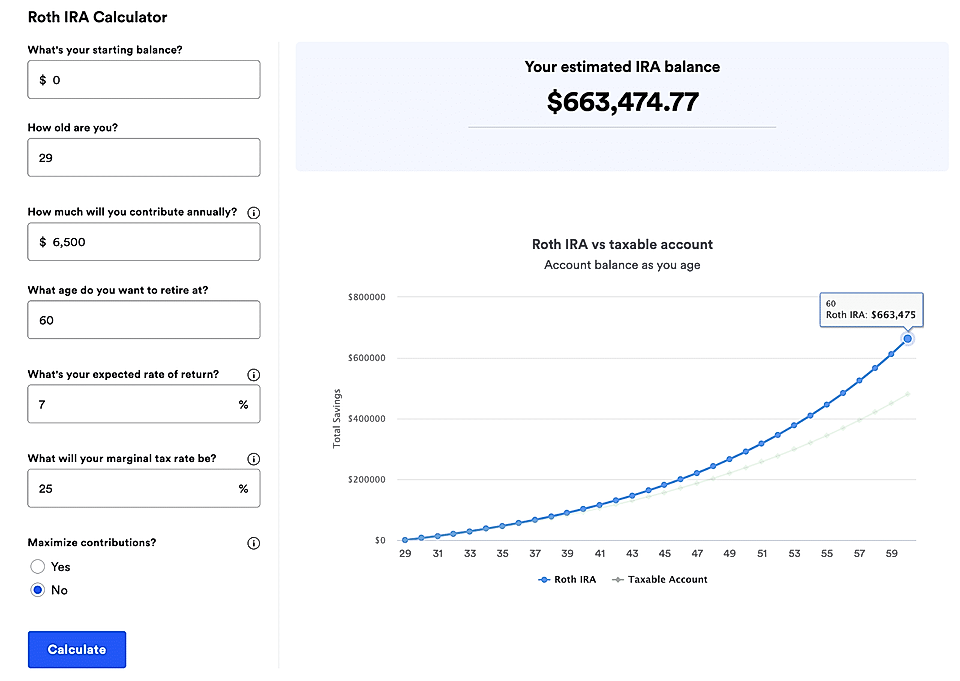
Roth IRA calculator showing estimated balance of $663,474.77 based on user inputs for retirement savings.

The contribution limit still applies

Backdoor Roth does not let you bypass IRA contribution limits. The strategy starts with an IRA contribution, so you are still governed by IRA contribution rules for that tax year. For the IRS overview of IRA contribution limits and related deduction rules, see: IRS: IRA contribution limits.

If you are trying to move substantially more into Roth beyond IRA limits, that is where employer-plan strategies may come in, like the Mega Backdoor Roth, but those depend on your plan features and cash flow.

What this means for high earners

When a Backdoor Roth is usually clean

The Backdoor Roth is often cleaner when:

  • You have no existing pre-tax IRA balances (including rollover IRAs, SEP IRAs, and SIMPLE IRAs), or you have a plan to address them.
  • Your traditional IRA contribution is clearly nondeductible, and you track it properly.
  • You and your CPA consistently file the right forms and keep records that can hold up years later.

This is the version that can feel almost too easy. It is also the version people assume they are doing, even when they are not.

When it can get messy fast

Things get complicated when you have other IRA money. Not because the strategy becomes illegal, but because the conversion is taxed based on the proportion of pre-tax and after-tax dollars across all your IRAs.

If you have a rollover IRA from an old 401(k), a SEP IRA from 1099 income, or a SIMPLE IRA from an older employer plan, you should pause and model the tax impact before you convert.

The two rules that trip people up

IRA aggregation rule

The IRA aggregation rule generally requires you to consider your IRA balances collectively for certain tax calculations. In plain English, the IRS is not just looking at the one IRA account you touched. They may look across your IRA universe when determining how much of your conversion is taxable.

This is one of the main reasons high earners end up surprised: they do a “small, simple” conversion and accidentally drag a larger pre-tax IRA balance into the tax math.

Pro-rata rule (the “cream in the coffee” problem)

The pro-rata concept is the heart of many Backdoor Roth mistakes. If you have both after-tax (nondeductible) and pre-tax IRA dollars, you generally cannot choose to convert only the after-tax portion. The IRS typically treats conversions as coming proportionally from both taxable and non-taxable amounts.

Your “cream in the coffee” analogy is the right mental model. Once the dollars are mixed across your IRA balances, each conversion can include some taxable and some non-taxable portion. That is why high earners care so much about keeping the Backdoor Roth clean and why planning matters before you click the convert button.

Reporting and documentation

Form 8606 and “lost basis”

If you make a nondeductible IRA contribution, Form 8606 is the cornerstone for documenting basis so you do not pay tax twice on the same dollars. Here is the form you referenced: IRS Form 8606 (PDF).

“Lost basis” is a real operational risk. If your after-tax contributions are not tracked properly and you cannot prove your basis later, you could end up paying tax again when you convert or withdraw. That is avoidable, but only if the reporting is consistent and recordkeeping is durable.

Timing and audit trail

The IRS does not publish a universal “required waiting period” between contribution and conversion. Some people separate the steps for clarity. Others do them quickly for operational simplicity. What matters most is that your documentation and tax reporting clearly reflect what happened, in the right tax year, with the correct basis tracking.

If you want additional IRS guidance on distributions and withdrawals from IRAs, including timing-related rules for retirement accounts, see: IRS Publication 590-B.

Centered image: documentation and workflow concept

Screenshot of a Traditional IRA Brokerage Account dashboard with options to convert, transfer money, or transact.

Common mistakes

  • Forgetting you have other IRAs. Rollover IRAs, SEP IRAs, and SIMPLE IRAs can change the tax outcome of a conversion.
  • Skipping Form 8606. If nondeductible basis is not reported, you can create “lost basis” and potential double taxation later.
  • Misunderstanding what is taxable. A conversion can be partly taxable even when the new contribution was after-tax, depending on your aggregated IRA balances.
  • Messy year-end tracking. Year-end IRA values can matter for pro-rata calculations. A conversion done early in the year is not necessarily isolated if you have other IRA balances later.
  • Doing the trade, not the strategy. A Backdoor Roth is a repeatable process that should fit inside a bigger tax plan, not a one-off hack.

Action steps

  1. Inventory every IRA you have. Traditional IRA, rollover IRA, SEP IRA, SIMPLE IRA. List the custodian and the approximate year-end value.
  2. Confirm whether your IRA contribution is deductible or nondeductible. High earners covered by a workplace plan often end up nondeductible, but it depends on the facts and filing status.
  3. Decide if you need a “clean-up” plan. If you have pre-tax IRA balances, coordinate with a CPA before converting so you understand the tax math.
  4. Execute the two steps and document them. Keep confirmations, contribution dates, conversion dates, and statements.
  5. Make Form 8606 non-negotiable. Treat it like a permanent record, not a one-year form you can recreate later.
  6. Coordinate across your team. If you have a financial advisor and a CPA, both should know what you did, when you did it, and why.

Key Takeaways

  • Backdoor Roth IRA can be a smart move for high earners who are phased out of direct Roth IRA contributions.
  • The mechanics are simple, but the tax outcome depends on IRA aggregation and pro-rata rules.
  • Form 8606 is central to avoiding lost basis and potential double taxation.
  • The cleanest Backdoor Roth is usually the one executed with minimal pre-tax IRA balances in the background.
  • This is a planning strategy. It works best when coordinated across your accounts, your CPA, and your long-term goals.

FAQ

What is a Backdoor Roth IRA?

A Backdoor Roth IRA is a two-step strategy where you contribute to a traditional IRA and then convert that amount to a Roth IRA. It is commonly used by high-income earners who are not eligible to contribute directly to a Roth IRA due to income limits.

How do I do a Backdoor Roth IRA step by step?

Step 1 is contributing to a traditional IRA (often nondeductible for high earners). Step 2 is converting to a Roth IRA. The details that matter are whether you have other IRA balances and whether your basis is properly tracked on Form 8606.

What is the pro-rata rule and why does it matter?

The pro-rata concept generally means you cannot convert only after-tax dollars if you also have pre-tax IRA money. Conversions can be treated as a proportional mix of taxable and non-taxable dollars across your aggregated IRA balances, which can create a tax bill even when your new contribution was after-tax.

What is the IRA aggregation rule?

The aggregation concept generally requires looking at your IRA balances collectively when determining the taxable portion of certain distributions or conversions. That is why a rollover IRA from an old 401(k), a SEP IRA, or a SIMPLE IRA can change the tax result of a Backdoor Roth conversion.

Do I have to file Form 8606 for a Backdoor Roth?

If you made a nondeductible traditional IRA contribution, Form 8606 is typically required to document basis so you do not pay tax twice. Here is the IRS form: IRS Form 8606 (PDF).

Can I do a Backdoor Roth if I have a rollover IRA, SEP IRA, or SIMPLE IRA?

You may be able to, but it can become more complex because those balances can affect how much of your conversion is taxable under pro-rata treatment. This is a situation where planning and modeling with a qualified tax professional can be worth it before you convert.

Internal Links

External Links

CTA

A Backdoor Roth IRA can be a strong move, but the value is in doing it cleanly and keeping it clean year after year. For high earners, that usually means coordinating your IRA strategy with your employer plan, your taxable investing, and your tax filing process.

If you want a second set of eyes on your IRA inventory, conversion approach, and documentation workflow, Tailored Wealth can help you build a repeatable system that holds up over time, including coordination with your CPA and automation-minded execution.

Disclaimer

The information provided is for educational and informational purposes only and does not constitute investment advice and it should not be relied on as such. It should not be considered a solicitation to buy or an offer to sell a security. It does not take into account any investor's particular investment objectives, strategies, tax status or investment horizon. 

No investment strategy or risk management technique can guarantee returns or eliminate risk in any market environment.

All investments include a risk of loss that clients should be prepared to bear. The principal risks of Tailored Wealth’s strategies are disclosed in the publicly available Form ADV Part 2A.

The views expressed in this commentary are subject to change based on market and other conditions. These documents may contain certain statements that may be deemed forward looking statements. Please note that any such statements are not guarantees of any future performance and actual results or developments may differ materially from those projected. Any projections, market outlooks, or estimates are based upon certain assumptions and should not be construed as indicative of actual events that will occur.

All information has been obtained from sources believed to be reliable, but its accuracy is not guaranteed. There is no representation or warranty as to the current accuracy, reliability, or completeness of, nor liability for, decisions based on such information and it should not be relied on as such.

Tailored Wealth and its advisors do not provide legal, accounting, or tax advice. Consult your attorney or tax professional. 

This content is for educational purposes only and is not tax, legal, or investment advice. Tax and retirement rules vary by state and change over time. Consult your professional advisors regarding your specific situation.