Frequently asked questions
How do I know if I have an RMD problem?
Project your pretax balance to your RMD age (73 or 75, depending on birth year) and divide by the IRS life expectancy factor, then add expected Social Security. If that forced income exceeds what you plan to spend, you likely have one. For Mark and Alina, $2.4 million today becomes about $5 million and a $200,000 first-year RMD.
Should I keep contributing pretax to my 401(k) if I already have $2 million or more pretax?
Often, yes, but not by default. In a 35% bracket, the deduction still has value. The question is whether some of your contribution room should go to Roth instead, through Roth deferrals, catch-ups, or a mega backdoor Roth, so your future RMDs don't keep growing.
Is it worth paying IRMAA to do bigger Roth conversions?
It can be. IRMAA adds a fixed surcharge per tier, so the real question is the all-in cost per converted dollar. In Mark and Alina's case, converting up to about $410,000 of MAGI cost around 29% all-in, compared with 32% to 35% on future RMDs. Our guide on when a Roth conversion actually makes sense shows how Tailored Wealth sizes these windows.
Should I pay off my mortgage when I retire?
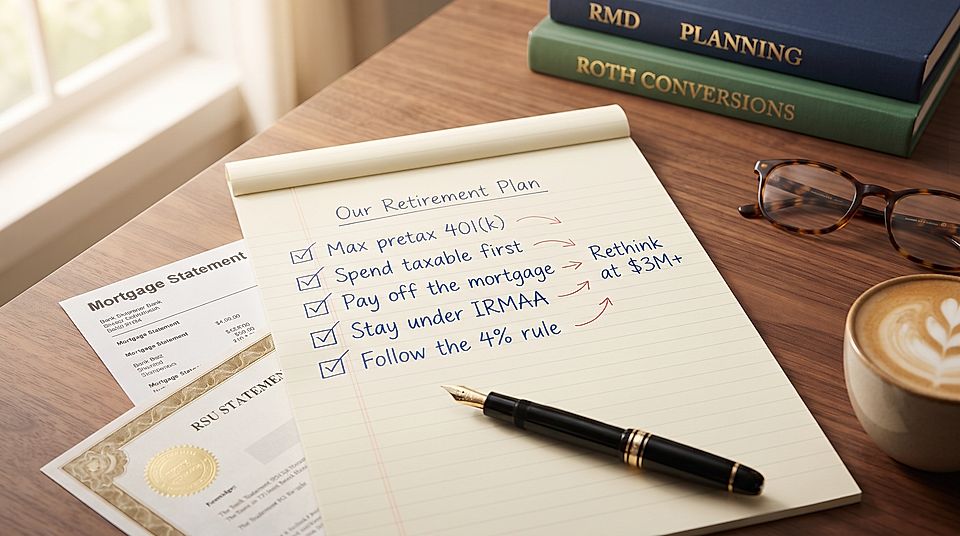
If the payoff money comes from pretax accounts, run the numbers first. Pulling a large lump sum can push you into high brackets and Medicare surcharges for a year. With a low fixed rate, paying it down gradually with planned bracket room is usually cheaper, though some people reasonably value being debt-free more.
Is the 4% rule too conservative for a $4 million portfolio?
For many couples with substantial Social Security, tapering spending, and large future RMDs, it can be. The rule assumes a worst-case 30-year period and flat spending, so it can push people to underspend and work longer than they need to.