See if a Wealth
Clarity Chat is
right for you.

Life Insurance Retirement Plans: Turning LIRPs into Powerful Retirement Tools

Silhouetted family discussing Life Insurance Retirement Plans amidst greenery, highlighting financial growth and security.

TL;DR Answer Box

A Life Insurance Retirement Plan (LIRP) uses a permanent life insurance policy’s cash value to create a retirement income stream, often through policy loans that can be tax-free if structured and managed correctly. LIRPs can be useful for high earners who are already maxing out traditional retirement accounts and want additional tax-advantaged flexibility, but they come with meaningful tradeoffs: higher costs, complexity, and lapse risk if loans or policy charges get out of control.

Last updated: February 11, 2026

Introduction

Let’s face it: when most people think of either life insurance or retirement planning, “exciting” isn’t the first word that comes to mind.

But when those terms are combined into a “Life Insurance Retirement Plan,” the mundane concept turns into a crafty strategy that could give you access to sizable loans you might not even need to pay back while you’re still alive.

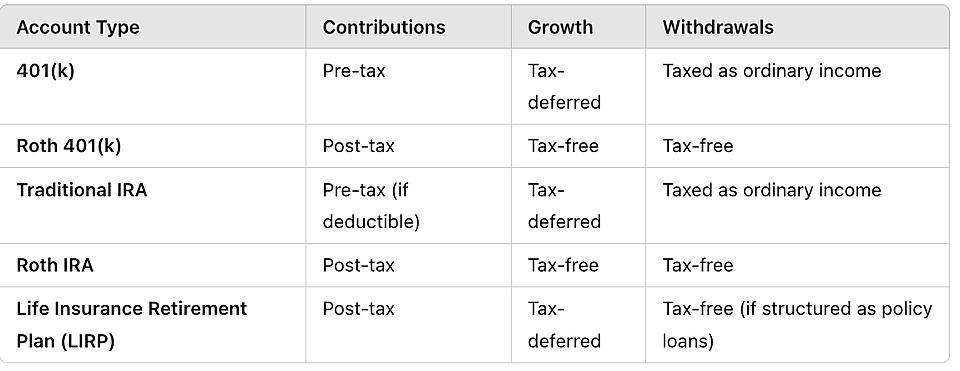
The Life Insurance Retirement Plan (LIRP) is a financial tool that combines the benefits of life insurance with the growth potential and tax advantages typically associated with retirement accounts.

Table comparing 401(k), Roth 401(k), Traditional IRA, Roth IRA, and LIRP on contributions, growth, and withdrawals.

In this LIRP guide, we’ll explore how high-earners can use LIRPs to keep more of what they’ve earned and learn about a few extra benefits.

What is a Life Insurance Retirement Plan (LIRP)?

A LIRP leverages permanent life insurance policies to provide retirement income.

Unlike term life insurance, which offers coverage for a specific period, permanent life insurance policies build cash value over time, which can be accessed during retirement.

Your cash value in a LIRP grows tax-deferred, and if structured correctly, withdrawals can be made tax-free.

The permanent life insurance umbrella category covers three distinct types of insurance:

  • Whole life insurance offers fixed premiums, a guaranteed cash value, and a death benefit. It provides the most stability but may have lower growth potential than other types.
  • Universal life insurance offers flexible premiums and death benefits. The cash value grows based on a fixed interest rate set by the insurer. It provides more flexibility but can be more complex to manage.
  • Indexed universal life insurance (IUL) is similar to universal life but ties the cash value growth to a stock market index like the S&P 500. This offers higher growth potential but comes with more risk.

How Do LIRPs Compare to Traditional Retirement Accounts?

Contribution Limits

LIRPs don’t have contribution limits, making them attractive for folks who want to save more.

401(k) and IRA contributions are capped annually; for 2024, the 401(k) limit is $23,000 (plus $7,500 catch-up if over 50), and the IRA limit is $7,000 (plus $1,000 catch-up if over 50).

Tax Deductibility

đŸ„ˆ LIRP contributions (premiums) aren’t tax-deductible, and you can’t reduce your taxable income by the amount of your contributions, unlike contributions to traditional IRAs or 401(k) plans. LIRPs offer tax-deferred growth and potentially tax-free withdrawals if structured properly, more on that below.

đŸ„‡ Contributions to 401(k)s and traditional IRAs are often tax-deductible, and the funds grow tax-deferred. Withdrawals are taxed as ordinary income. Roth IRAs offer tax-free withdrawals but have income and contribution limits.

Withdrawal Flexibility

đŸ„‡ LIRPs do not have RMDs, providing more flexibility in accessing funds.

đŸ„ˆ Traditional retirement accounts have required minimum distributions (RMDs) starting at age 72 (subject to current law).

Additional Considerations

LIRPs include a death benefit, which can provide additional financial security for your beneficiaries.

So, you essentially get some of the most significant benefits of retirement accounts with a significant lump sum that can be paid to your loved ones in the unlikely and unfortunate scenario of your passing.

How LIRP “Tax-Free Withdrawals” Work

As noted above, you contribute after-tax dollars to your permanent life insurance policy through premiums, and the cash value within a policy grows tax-deferred. If you were to access your growth, you’d pay taxes on it as ordinary income. However, policy loans (more on below) can allow you to avoid that entirely.

Part of your premiums pay for the life insurance aspect, and part grows within the account.

So, as the cash value accumulates over the years, you don’t pay tax on the growth, similar to the tax-deferred growth in traditional retirement accounts like IRAs and 401(k)s.

LIRPs allow you to access the accumulated cash value to provide a retirement income stream through a mix of policy loans and withdrawals.

Policy Loans

You can borrow against the cash value of your life insurance policy.

These loans aren’t considered taxable income because they are technically loans that must be repaid and usually come with favorable interest rates compared to other borrowing options.

Withdrawals

Direct withdrawals from the cash value are tax-free up to the amount of premiums paid.

Your profit (amount withdrawn beyond the premiums) is taxable as ordinary income.

How to Structure a LIRP Correctly

Plan to avoid direct withdrawals as a first resort since the amount exceeds the total premiums paid into the policy.

Instead, many strategies aim to access cash via policy loans.

While it’s possible to repay these loans, many policyholders plan to keep the loan outstanding until death.

The death benefit is then used to pay off the loan balance, and the remaining amount is tax-free to the beneficiaries.

Important: if the loan balance gets too high relative to the cash value, the policy could lapse, leading to a significant tax liability. Work with a qualified professional to monitor the loan-to-cash-value relationship and policy performance over time.

A LIRP in Motion: A Practical Example

Richard has a life insurance policy with a significant cash value. He paid $200,000 in premiums over several years, and his cash value has grown to $500,000. His death benefit is $1,000,000.

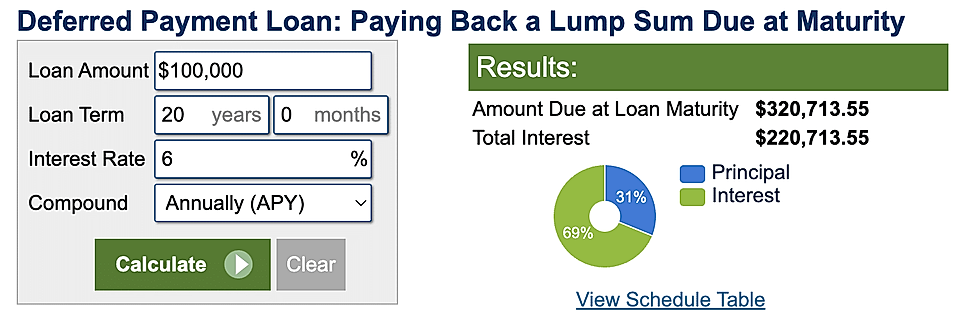
Richard takes a policy loan of $100,000 at 6% APY compounded annually. The loan isn’t taxed as income.

If Richard decides not to repay the loan or the interest during his lifetime, the outstanding loan balance and its interest will be deducted from the death benefit of $1,000,000.

Calculator for a deferred payment loan showing $100,000 loan amount, 20-year term, 6% interest, total due $320,713.55.

Let’s assume Richard meets his maker in 20 years. His total amount due would be $320,713.55, meaning $220,713.55 would be the total interest accumulated over the loan’s duration.

All of this would be deducted from his net death benefit, leaving his beneficiaries $679,286.45 tax-free.

Alternatively, Richard could pay the interest regularly and prevent the loan balance from increasing exponentially, which reduces the risk of the policy lapsing due to a ballooning loan balance.

Policy Lapses and How to Prevent Them

A policy lapse occurs when the cash value is insufficient to cover the policy’s costs and the outstanding loan balance.

How This Could Happen

  • As interest accrues annually, it compounds and increases the loan balance significantly over time. If the interest is not paid, it is added to the loan principal, causing the debt to grow.
  • The policy has ongoing costs, including the cost of insurance and administrative fees. If these aren’t adequately funded, charges can reduce cash value over time.
  • If the loan balance and policy costs deplete the cash value, the policy may lapse.

Preventing Policy Lapses

  • Make regular interest payments out-of-pocket when appropriate.
  • Continue paying premiums to support policy costs and keep cash value healthy.
  • Monitor the policy’s cash value and loan balance to ensure sustainability.
  • Tailor the policy design to your needs (funding pattern, loan strategy, index crediting assumptions, etc.).

Making Cents of LIRPs

A well-structured LIRP strategy can provide a significant, tax-advantaged surge of cash during retirement, supplementing other retirement accounts.

LIRPs shine bright when you consider that policy loans aren’t considered income when managed properly.

On one hand, if your cash balance in your LIRP has appreciated significantly, you could take out a hefty loan that allows you to coast through retirement, resting easy on your calculations that your repayment will come from your death benefit.

On the other hand, you can repay the interest as you would any other loan using funds from, let’s say, your traditional retirement accounts and keep the death benefit entirely intact for your beneficiaries.

As we wrap up our discussion on Life Insurance Retirement Plans (LIRPs), let’s distill the key advantages and drawbacks.

LIRP Perks

  • Potential tax-free distributions (if structured as policy loans)
  • Tax-free death benefit for beneficiaries
  • Often a guaranteed or contractually defined crediting method (depends on policy type)
  • Growth potential (varies by policy design and assumptions)
  • Accelerated benefit riders (in some policies) that allow death benefit access in qualifying events
  • No RMDs

LIRP Cons

  • Premiums are not tax-deductible
  • Costs can be higher due to insurance charges and fees
  • Complexity: performance depends on policy design, funding, and loan management
  • Guaranteed rates/crediting may be lower than other investment options
  • Policy lapse risk can create unexpected taxable income

No other retirement savings accounts include the added benefit of disbursing a large lump sum of cash to your loved ones as a death benefit. However, they’re also useful for folks who want additional tax-advantaged flexibility beyond traditional retirement accounts.

Discussing how LIRPs fit into your broader retirement picture with a financial planner can help you determine whether they meet your current and future needs.

Key Takeaways

  • LIRPs can create tax-advantaged retirement income through policy loans when structured and monitored correctly.
  • They are not a replacement for core retirement accounts for most people, think of them as a specialized tool.
  • Policy lapse is the big risk. Unpaid loan interest + policy costs can collapse the plan and trigger taxes.
  • Costs and complexity are real. Fees and insurance charges are part of what you’re buying.
  • Fit matters. LIRPs tend to make more sense for high earners with maxed-out traditional options and estate goals.

FAQ

Are LIRP loans really tax-free?

Loans are generally not treated as taxable income, but if a policy lapses or is surrendered with loans outstanding, taxes can be triggered.

Do I need a LIRP if I already have a 401(k) and IRA?

Not necessarily. Many people are better served maxing traditional accounts first, then evaluating LIRPs as an advanced planning tool.

What’s the biggest mistake people make with LIRPs?

Over-borrowing without monitoring cash value and loan growth. This can cause a lapse and a surprise tax bill.

Disclaimer

The information provided is for educational and informational purposes only and does not constitute investment advice and it should not be relied on as such. It should not be considered a solicitation to buy or an offer to sell a security. It does not take into account any investor's particular investment objectives, strategies, tax status or investment horizon. 

No investment strategy or risk management technique can guarantee returns or eliminate risk in any market environment. All investments include a risk of loss that clients should be prepared to bear. The principal risks of Tailored Wealth’s strategies are disclosed in the publicly available Form ADV Part 2A.

The views expressed in this commentary are subject to change based on market and other conditions. These documents may contain certain statements that may be deemed forward looking statements. Please note that any such statements are not guarantees of any future performance and actual results or developments may differ materially from those projected. Any projections, market outlooks, or estimates are based upon certain assumptions and should not be construed as indicative of actual events that will occur.

All information has been obtained from sources believed to be reliable, but its accuracy is not guaranteed. There is no representation or warranty as to the current accuracy, reliability, or completeness of, nor liability for, decisions based on such information and it should not be relied on as such.

Tailored Wealth and its advisors do not provide legal, accounting, or tax advice. Consult your attorney or tax professional. 

This content is for educational purposes only and is not tax, legal, or investment advice. Tax and retirement rules vary by state and change over time. Consult your professional advisors regarding your specific situation.