
See if a Wealth
Clarity Chat is
right for you.

Tired of Corporate, But Not Ready to Quit? There Is a Third Option.

Desk with coffee mug, open notebook and pen beside a balance board with stones and blocks at sunset skyline

TL;DR Quick Answer

Most executives assume there are only two options: stay in corporate full-time or retire completely. Hybrid retirement is the third path. It combines flexible consulting, advisory, or fractional work with a three-layer portfolio structure that eliminates forced selling in a downturn, cuts the portfolio withdrawal rate in half, and makes work optional years before traditional retirement age. The four mistakes that wreck the transition are leaving without a liquidity bridge, treating taxes as an afterthought, waiting too long on healthcare, and underestimating the identity shift.

A client said something to me recently that I hear almost every week.

"I can keep doing this job. I just don't want to do it at this intensity for another ten years."

He was a chief revenue officer at a SaaS company. Great income, strong bonus, a team he had built. From the outside, a success story. On the inside, he was tired. Not tired of working. Tired of the pressure, the travel, and the weight of carrying a number every quarter.

Here is what surprised him. His problem was not a money problem. He had a 401(k), a brokerage account, RSUs, and cash. What he did not have was a path. No one had ever shown him anything between "grind for another decade" and "stop cold and hope the portfolio holds."

There is a third path. This post covers how it works, the portfolio structure that makes it safe, and the four mistakes that quietly wreck the transition.

The Third Option - How Hybrid Retirement Actually Works

The framework

What Hybrid Retirement Actually Is

Most people think there are only two choices. Keep working, or retire completely. That is how nearly all retirement planning is built: work for thirty or forty years, save aggressively, then one day flip the switch and stop.

Life rarely works that way. Most high performers do not wake up one morning wanting to do nothing. They want to shed the responsibility, the deadlines, and the calendar that runs their life. They just don't want work to consume everything anymore.

Hybrid retirement is the space in between. Instead of going from a hundred to zero overnight, you gradually redesign your work to fit the life you actually want. Consulting, board seats, fractional leadership, advising, or a small business you're genuinely excited to build. You keep earning income, but on your terms.

For a lot of executives, that is a far easier transition than walking away completely. It is also, quietly, a much smarter financial move. The hybrid retirement framework is built for exactly this kind of flexible, purposeful next chapter. Work becomes optional. Income becomes flexible. Purpose stays central.

The math

How Hybrid Income Changes the Portfolio Math

Here is what this looks like in real numbers. Say your lifestyle costs $250,000 a year. Most people assume you need to pull the full $250,000 from your portfolio every year. But what happens when hybrid work covers part of that?

Side-by-side comparison of income sources and portfolio withdrawal rates with and without hybrid income.

That single change is bigger than it looks. The biggest risk in the early years of any transition is not running out of money someday. It is putting too much pressure on the portfolio too soon, especially if markets don't cooperate. Cutting the withdrawal rate in half gives your investments room to breathe, time to recover, and time to compound. That is the structural advantage of hybrid retirement over a hard stop.

The structure

The Three-Layer Portfolio That Makes the Transition Safe

The CRO's portfolio was not the problem. The structure was. Like most successful executives, he had plenty of assets sitting in one giant undifferentiated bucket. That is fine while a steady paycheck is covering the bills. It is dangerous the moment that paycheck goes away.

Money you need next year should never be invested the same way as money you won't touch for fifteen years. So we organized everything into three layers.

Three-layer financial strategy diagram: liquidity, hybrid income, and long-term growth with brief explanations.

This is the same time-horizon thinking behind Life Driven Investing, where every dollar is matched to when you'll actually need it. The moment the CRO's money was structured this way, his question changed. He stopped asking "can I afford to leave?" and started asking "how much flexibility do I actually want?"

The concerns

The Two Things That Always Come Up

Two-column text graphic about healthcare and taxes, with headings and paragraphs on retirement planning.

This is exactly why we model the transition over several years. The same discipline is covered in the Executive Compensation Planning 2026 Playbook. Every major income source, RSU proceeds, severance, deferred comp distributions, and consulting fees, needs to be sequenced intentionally across the tax years surrounding your exit, not reacted to after they hit.

What goes wrong

The Four Mistakes That Wreck the Transition

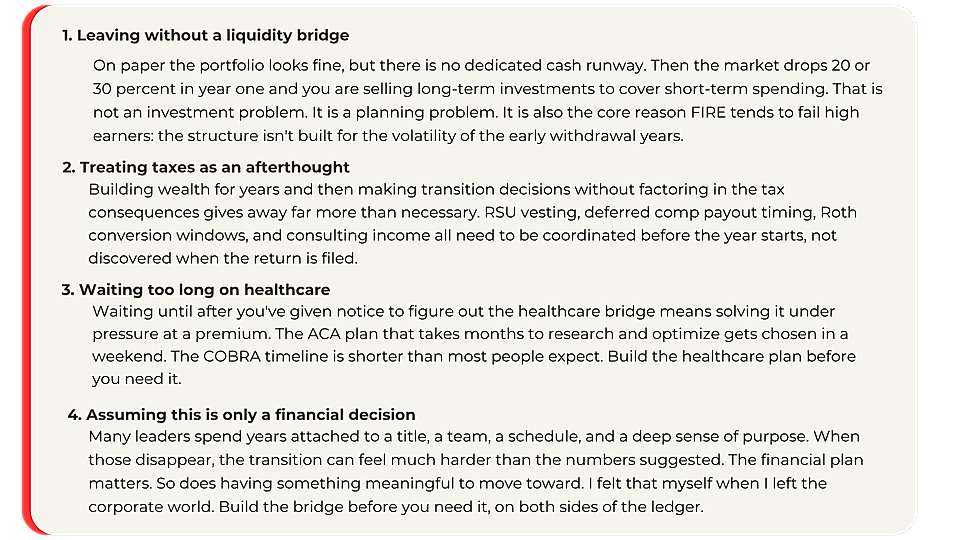
Infographic listing four retirement transition mistakes: liquidity bridge, taxes, healthcare, and purpose.

Before and After

Before-and-after comparison of retirement planning challenges and solutions, shown as two bullet lists.

At Tailored Wealth, this is the work we do every day. We help corporate executives design a hybrid retirement that makes work optional without giving up income, purpose, or lifestyle. We map your next 1, 5, and 10-plus years, then build the three-layer structure around them so no downturn ever forces your hand. We coordinate your equity comp, severance, and deferred comp across multiple tax years. We model your healthcare gap before you leave. And we keep the plan moving through a quarterly rhythm so it stays a living plan instead of a binder on a shelf.

The executives who make this transition well don't make emotional decisions. They make planned ones. They build the bridge before they need it. If you're curious what the numbers look like for your specific situation, the hybrid retirement strategy post is a useful starting point.

Key Takeaways

  • Hybrid retirement is the third path between grinding another decade and stopping cold. Work becomes optional. Income becomes flexible. Purpose stays central.
  • Hybrid income, consulting, advisory, board seats, cuts the portfolio withdrawal rate dramatically. $125,000 of flexible income on a $250,000 lifestyle drops the withdrawal rate from 5% to 2.5% on the same portfolio.
  • The three-layer portfolio structure (liquidity, hybrid income, long-term growth) is what makes the transition financially safe. Money you need soon should never be invested the same as money you won't touch for fifteen years.
  • Layer 1, the liquidity bridge, is the single most important thing to have in place before making any transition move. Without it, a market downturn in year one forces the selling of long-term assets at exactly the wrong time.
  • Healthcare and taxes must be built into the plan before you leave, not figured out after. Both are solvable. Both are expensive to solve under pressure at the last minute.
  • The identity transition is as real as the financial one. Having something meaningful to move toward, not just away from, makes the whole thing work.
  • The executives who make this transition well build the bridge before they need it. On both sides.

Frequently Asked Questions

How much hybrid income do I actually need for this to work?

There is no single number, but the goal is not to replace your full corporate salary. It is to take enough pressure off the portfolio that the withdrawal rate drops into a sustainable range, typically below 3.5% depending on your portfolio size and timeline. For most executives we work with, $50,000 to $150,000 in flexible hybrid income during the transition years is enough to change the math significantly. The specific amount depends on your lifestyle spending, your portfolio balance, your other income sources, and when Social Security and any deferred comp distributions begin. A coordinated model of all these inputs is what tells you your actual number, not a rule of thumb.

What counts as hybrid income in retirement planning?

Hybrid income includes any earned income you generate on your own terms after leaving full-time corporate work. Common forms include consulting agreements with one or two clients, fractional executive roles at a company where you bring strategic value, board or advisory seats with a retainer, speaking or writing if your expertise supports it, and investment or ownership stakes in businesses where you contribute meaningfully. The key is that the intensity and schedule are yours to control, not a full-time employer's. Subject to your specific tax situation, self-employment income from consulting or advisory work is generally subject to federal and state income tax and self-employment tax, so the income plan should be modeled with those obligations factored in.

How do you handle healthcare between leaving corporate and Medicare at 65?

The healthcare bridge is one of the most important planning items before any transition and one of the most commonly underestimated costs. Options typically include COBRA continuation coverage for up to 18 months after leaving an employer, ACA marketplace plans where premium tax credits may be available if your income is managed carefully in the transition years, coverage through a spouse's employer plan if available, or a combination of these across different years. The right structure depends on your family situation, your health needs, your expected income level during the bridge years, and the specific plans available in your state. This needs to be modeled and decided before you give notice, not after.

What tax issues come up most often in the transition year?

The most common issue is income stacking: RSU vests, severance, deferred comp distributions, and consulting income all landing in the same tax year without coordination. This can push a high earner into peak marginal brackets in the exact year they were planning to benefit from lower income. The second most common issue is missing the Roth conversion window that opens up in the low-income years between leaving corporate and deferred comp or Social Security starting. If those years aren't modeled in advance, the window closes before it's used. Both issues are avoidable with multi-year planning. At Tailored Wealth, we model every significant income event across the transition years so nothing lands as a surprise.

How does Tailored Wealth help executives structure a hybrid retirement?

We build the full transition architecture as part of our Life-Driven Planning process: mapping the three-layer portfolio structure to your specific timeline, modeling hybrid income scenarios alongside your equity comp and deferred comp events, building the healthcare bridge before you leave, and running multi-year tax projections so the transition is coordinated rather than reactive. We use professional planning software to show you exactly what the numbers look like under different exit dates, income levels, and market scenarios. The Quarterly Strategy Rhythm keeps the plan current as your equity events, consulting income, and life circumstances evolve. The goal is a designed transition, not a hope-and-check approach.

Related Reading

How to Build a Hybrid Retirement Plan That Makes Work Optional — The full step-by-step framework for designing a phased exit from full-time corporate work.

Redefining Retirement: The Hybrid Strategy That Makes Work Optional — What hybrid retirement looks like in practice and why it fits executive life better than a hard stop.

Your Portfolio Needs a Job Description — The Life Driven Investing framework that underlies the three-layer portfolio structure in this post.

Executive Compensation Planning 2026: Your Playbook — How to coordinate RSUs, deferred comp, and severance across the tax years surrounding an exit.

FIRE Without the Burnout — Why FIRE fails high earners and what a more realistic work-optional framework looks like.

Why Hybrid Living Beats Full Retirement — The case for purpose-driven, flexible work over a fixed retirement date.

External Resources

Healthcare.gov: Coverage Options for Early Retirees — Guidance on ACA marketplace plans, premium tax credits, and COBRA for executives who step back before Medicare eligibility at 65.

IRS: Exceptions to the Early Distribution Penalty — Official IRS guidance on the Rule of 55 and other exceptions to the 10% early withdrawal penalty for retirement account distributions.

Subscribe to Making Sense of Your Money for practical insights that help business leaders make smarter financial decisions with confidence:

Disclosure

The information provided is for educational and informational purposes only and does not constitute investment advice and it should not be relied on as such. It should not be considered a solicitation to buy or an offer to sell a security. It does not take into account any investor's particular investment objectives, strategies, tax status or investment horizon.

No investment strategy or risk management technique can guarantee returns or eliminate risk in any market environment.

All investments include a risk of loss that clients should be prepared to bear. The principal risks of Tailored Wealth's strategies are disclosed in the publicly available Form ADV Part 2A.

The views expressed in this commentary are subject to change based on market and other conditions. These documents may contain certain statements that may be deemed forward looking statements. Please note that any such statements are not guarantees of any future performance and actual results or developments may differ materially from those projected. Any projections, market outlooks, or estimates are based upon certain assumptions and should not be construed as indicative of actual events that will occur.

All information has been obtained from sources believed to be reliable, but its accuracy is not guaranteed. There is no representation or warranty as to the current accuracy, reliability, or completeness of, nor liability for, decisions based on such information and it should not be relied on as such.

Tailored Wealth and its advisors do not provide legal, accounting, or tax advice. Consult your attorney or tax professional.