
See if a Wealth
Clarity Chat is
right for you.

🏗 Engineer Your W-2 Side Hustle Income Before It Hurts

A businessman in a suit sits at a desk with paperwork, facing a city skyline at night with lights and an American flag visible.

TL;DR Answer Box

At $500K+ W-2 income, “maxed 401(k)” is not a strategy, it’s a starting line. High earners reduce tax drag by building infrastructure: (1) an entity that captures income you control outside your W-2 (and unlocks legitimate deductions and better tax treatment), and (2) stacked retirement “shelters” tied to that entity (often a Solo 401(k) and, when appropriate, a defined benefit plan). The goal isn’t gimmicks. It’s structure, documentation, and multi-year planning.

Last updated: January 28, 2026

At $500K+ W-2 income, normal rules stop applying. It can feel like you’re fighting less for gains and more to survive tax-wise.

High earners who thrive don’t just grind harder, they learn to play the system smarter. They build infrastructure, weaponize volatility, and steer every dollar with precision.

Today, we’re breaking down two elite moves, and why most top earners are still burning cash without realizing it.

đŸŠŸ Entity Engineering: Build Your Tax Machine

W-2 income is structurally rigid: full payroll withholding, limited deduction lanes, and very little flexibility around timing. That’s why many high earners build a separate “income engine” outside their employer, so at least some of their income runs through rules they can control.

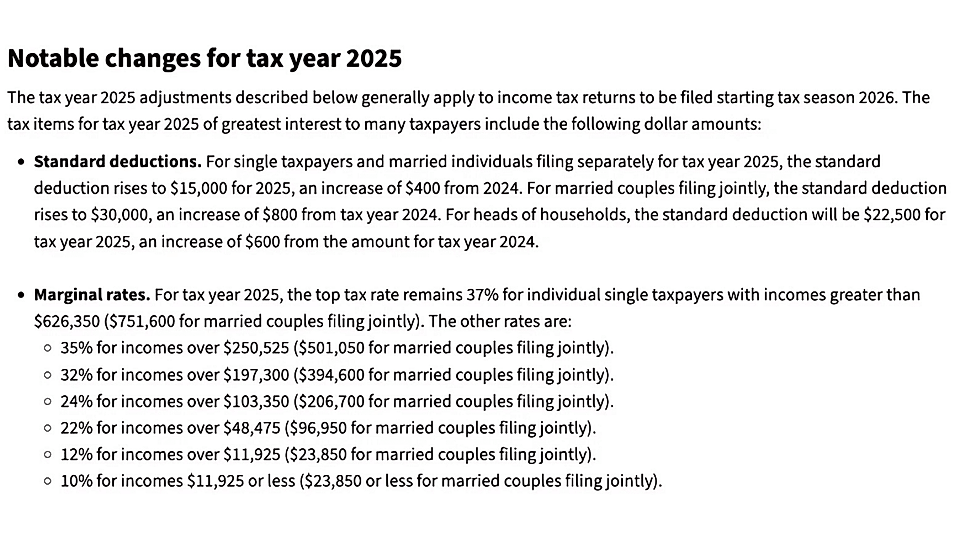
Overview of notable tax changes for 2025 including standard deductions and marginal tax rates for various filing statuses.

Wall Street execs have had some version of this for decades. By creating a separate business entity (often with S-Corp taxation when it fits), you can gain control over how and when new income is received.

Let’s be dead clear:

  • An LLC by itself does not lower your W-2 income or W-2 taxes.
  • ✅ A side business set up properly can optimize taxes on business income you control.
  • ❌ It does not change how your employer taxes your salary. That W-2 is locked in.

Why S-Corp taxation can matter (when it fits)

When you earn business income directly (sole prop / Schedule C), you generally pay self-employment tax on net profit (in addition to income tax), subject to rules and thresholds.

With S-Corp taxation, you typically pay payroll taxes on a reasonable salary, and remaining profit may be distributed as distributions (which can reduce exposure to certain payroll taxes compared to pure Schedule C treatment, fact dependent and must be structured correctly).

Important: the savings are not automatic. They come from:

  • clean bookkeeping and documentation,
  • reasonable salary support,
  • legitimate deductions that match your business activity,
  • and correct tax filing.

The “first steps” structure (simple version)

  • Create a personal LLC (and evaluate whether S-Corp taxation makes sense).
  • Define a reasonable salary if S-Corp taxation is elected.
  • Track and substantiate qualified business deductions (ordinary and necessary, with receipts and a clean paper trail).

Advanced layering (not blanket prescriptions)

Then you can get more strategic, if your business model supports it and your tax/legal team signs off. Examples include:

  • IP-holding company: Own trademarks, digital products, courses, or licensing assets and structure royalty/licensing flows appropriately.
  • Family management company: A legitimate admin/services entity with real work, real invoices, and real documentation, useful for building systems and future scaling.

I share those last two points to get the creativity wheels spinning, not as an automatic recommendation. The rule is simple: substance first, structure second.

Video: High Earners How a Side Hustle Can Slash Your Taxes and Build Wealth

Your browser does not support the video tag.

đŸ”„ Retirement Shelter XXL: Stack Deferrals the Right Way

Maxing out your employer 401(k) is a solid move, but for high earners, it’s often just the baseline. The “next level” is adding a second income source (business income) so you can unlock additional retirement shelters tied to that income.

The finesse: contribute more in monster income years, throttle back when earnings dip, and keep liquidity expectations realistic.

How the stacking can look (conceptual)

  • Solo 401(k) / Individual 401(k): Contribution capacity depends on your business income, plan design, and annual IRS limits.
  • Defined benefit / cash balance plan: Can allow very large deductible contributions (often six figures+), but requires actuarial design and ongoing funding discipline.
  • 457(b) and other deferred comp lanes: Sometimes available through employers; separate rules apply and the details matter.

Watch out: defined benefit plans can feel like handcuffs if your cash flow isn’t stable. Once you start, the plan expects a funding rhythm. Set it up only when the business income is durable enough to support it.

Most players are stuck at “I think I maxed my 401(k).” Meanwhile, structured earners can be building far more tax-advantaged capacity, quietly, because their income is engineered to support it.

đŸ’Œ W-2 Side Hustle in Practice

Now meet Alina, a CFO with a bloated W-2 and rising income from coaching and author royalties.

Before the strategy, she ran it through a Schedule C, messy, exposed, and overtaxed.

After restructuring, she:

  • improved her ability to qualify for pass-through planning lanes (where applicable),
  • cleaned up deductions with better documentation and entity separation,
  • built a retirement “stack” that matched her income volatility (Solo 401(k) + long-term shelter planning, when appropriate),
  • segmented her IP/royalties into a cleaner structure for liability and clarity (fact-dependent).

Same human, two legal tax profiles. One set of income gets retirement benefits. Another gets treated like royalty flow, each with its own planning lane.

🎯 Making Sense of Your W-2 Side Hustle Strategy

This is the meta-game.

The point isn’t just to save on taxes, it’s to strategically set your moves multiple years out so your money flows intelligently, even when chaos hits.

By engineering your income, reducing tax drag, and keeping optionality alive, you’ll surprise yourself with how much wealth you can protect.

At this level, end-of-year defense alone won’t cut it. Strategic infrastructure wins.

Key Takeaways

  • At $500K+ W-2 income, optimization comes from structure: build controllable income outside your paycheck so you can influence timing, deductions, and retirement capacity.
  • An entity doesn’t “fix” your W-2, it creates a compliant lane for new income you control, with cleaner documentation and planning flexibility.
  • S-Corp savings (when appropriate) are earned, not assumed: reasonable salary, clean books, and real business substance drive outcomes.
  • Business income unlocks retirement stacking: Solo 401(k) plus (when cash flow supports it) a defined benefit/cash balance plan can materially expand tax-sheltered space.
  • Infrastructure beats last-minute tactics: multi-year planning + documentation reduces audit risk and compounds after-tax wealth faster than “creative” one-off moves.

FAQ

Will an LLC reduce my W-2 taxes?

No. Your W-2 compensation is taxed through your employer’s payroll system. An LLC (or S-Corp election) can help optimize separate business income you control, but it does not change your employer’s withholding or W-2 tax treatment.

When does S-Corp taxation actually help?

Potentially when you have meaningful, ongoing profit from a real business activity and can support a reasonable salary with proper payroll, bookkeeping, and documentation. It’s fact-dependent and must be implemented correctly to be defensible.

What counts as a “side business” that supports this strategy?

Something with real economic activity: consulting, coaching, speaking, content/products, software, licensing/royalties, advisory work, or other services/products sold for profit, supported by invoices, contracts, separate banking, and clean records.

What are “ordinary and necessary” deductions?

Expenses that are common and appropriate for your specific business and directly connected to earning that income. The key is substantiation: receipts, business purpose, and clear separation from personal spending.

How much side income do I need before this is worth it?

There’s no universal threshold. It depends on profit level, consistency, payroll/filing costs, and the retirement plan opportunity you’re trying to unlock. In practice, this becomes more compelling as side-income profit becomes durable and the tax/retirement benefits outweigh the added complexity.

Can I open a Solo 401(k) if I already max my employer 401(k)?

Often yes if you have self-employment income, but contribution limits and coordination rules can get technical across multiple plans. Plan design matters (employee vs. employer contributions) and should be coordinated with your CPA/TPA.

When does a defined benefit (cash balance) plan make sense?

Most often when you have high, stable business income and want very large deductible contributions over multiple years. These plans require actuarial setup and an ongoing funding rhythm so they’re best when cash flow is durable.

What’s the biggest mistake people make with entity/tax strategies?

Creating structure without substance: messy books, weak documentation, unrealistic “reasonable salary,” mixing personal and business expenses, or setting up retirement plans without stable cash flow to support them.

Do I need a CPA and a plan administrator (TPA) for this?

Usually, yes. A CPA helps with entity/tax compliance and filings. A TPA typically designs/administers retirement plans like Solo 401(k)s (depending on provider) and especially defined benefit/cash balance plans.

Does this work if most of my income is equity comp (RSUs/options)?

It can, but the planning is more nuanced. Equity events can spike AGI and affect deductions, credits, and retirement/tax opportunities. The clean approach is to model equity timing alongside business income, entity structure, and retirement contributions.

CTA

If you’re a high-earning W-2 professional with meaningful side income (or you’re building one), we can map the cleanest structure: entity setup, deduction lanes, retirement stacking, and a multi-year plan that stays compliant.

Disclaimer

The information provided is for educational and informational purposes only and does not constitute investment advice and it should not be relied on as such. It should not be considered a solicitation to buy or an offer to sell a security. It does not take into account any investor's particular investment objectives, strategies, tax status or investment horizon. 

No investment strategy or risk management technique can guarantee returns or eliminate risk in any market environment. All investments include a risk of loss that clients should be prepared to bear. The principal risks of Tailored Wealth’s strategies are disclosed in the publicly available Form ADV Part 2A.

The views expressed in this commentary are subject to change based on market and other conditions. These documents may contain certain statements that may be deemed forward looking statements. Please note that any such statements are not guarantees of any future performance and actual results or developments may differ materially from those projected. Any projections, market outlooks, or estimates are based upon certain assumptions and should not be construed as indicative of actual events that will occur.

All information has been obtained from sources believed to be reliable, but its accuracy is not guaranteed. There is no representation or warranty as to the current accuracy, reliability, or completeness of, nor liability for, decisions based on such information and it should not be relied on as such.

Tailored Wealth and its advisors do not provide legal, accounting, or tax advice. Consult your attorney or tax professional. 

This content is for educational purposes only and is not tax, legal, or investment advice. Tax and retirement rules vary by state and change over time. Consult your professional advisors regarding your specific situation.