TL;DR Answer Box
TL;DR: A hybrid retirement plan helps high earners retire gradually by combining flexible work income, tax-aware withdrawals, and time-horizon investing so work becomes optional sooner without making the plan fragile. The goal is not a single retirement date. The goal is a work-optional date backed by a real model that integrates taxes, healthcare, Social Security, and your portfolio. Last updated: March 23, 2026
Introduction
Let me describe a conversation I have more than any other.
An executive in their late 40s or early 50s comes in. They are successful, well-compensated, and by almost any outside measure, doing everything right. But when I ask what they actually want the next decade to look like, the answer is almost always some version of the same thing.
“I do not want to keep doing this at this pace. But I am not ready to just stop.”
They are not burned out in a dramatic way. They are tired of the pace being non-negotiable. They want more choice. More breathing room. Work that feels meaningful on their terms, not someone else’s calendar.
The problem is they do not have a plan for that. They may have a retirement number. They may have a Monte Carlo score. They may have a vague assumption like “I will work until 65” that they have never stress-tested. But they do not have a model for how partial work, phased income, smarter taxes, and a different pace can work together.
By the end of this article, you will know how to build a hybrid retirement plan that makes work optional sooner, while keeping the plan resilient.
The false choice most high earners are stuck in
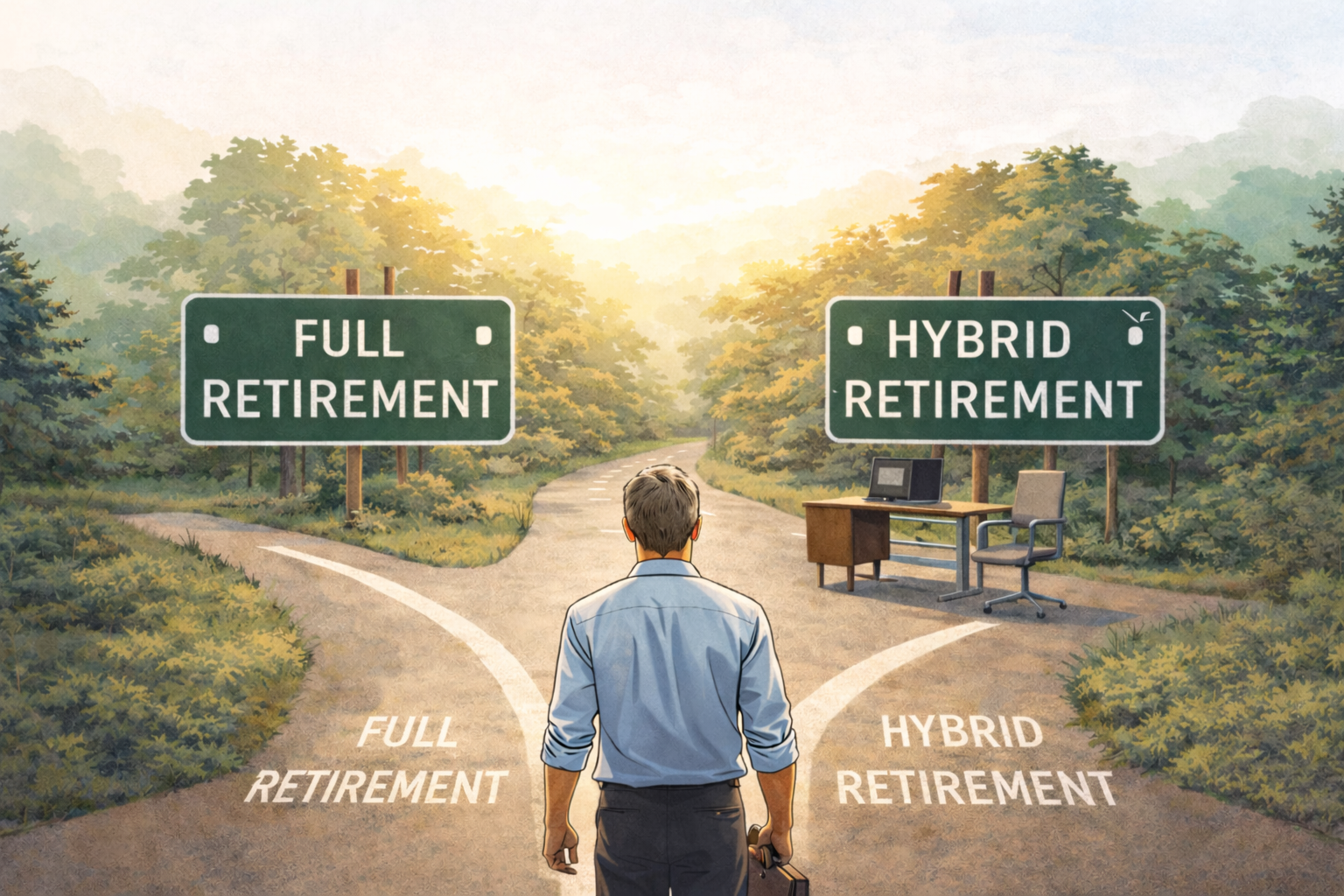
Traditional retirement is usually presented like a light switch. You work. Then one day, you do not.
For many executives, that is not emotionally realistic or financially optimal. You have spent decades building expertise, relationships, and identity around work. Going from full intensity to zero overnight does not just feel scary. It often does not even feel desirable.
And the data backs up the idea that people want options. WTW found that 34% of workers age 50 and older have already started phasing into retirement or want to. Meanwhile, EBRI’s Retirement Confidence Survey has consistently shown a meaningful gap between what workers expect and what retirees experience, including many retirees leaving earlier than planned.
The better mental model is a dimmer switch, not a light switch. The goal is not to stop working. The goal is to reach the point where you are choosing to work, and choosing what that work looks like.
What hybrid retirement actually is
Hybrid retirement is not “semi-retirement by accident.” It is a deliberate, structured plan.
It means designing a model where flexible work income, tax-aware withdrawals, and time-horizon investing work together.
The work component might be consulting, a board role, fractional leadership, project work, teaching, or a business that runs at a different pace. The point is that it is chosen, not defaulted into.
The planning inputs go beyond assets and expenses. You also need to define:
- How many days per week you want to work.
- What income range would make that work feel attractive.
- Which years you need healthcare solved independently.
- What you want more room for, and what kind of work still feels meaningful.
This is a design problem as much as a math problem.
If you want the deeper framework, start here: Redefining Retirement: The Hybrid Strategy That Makes Work Optional.
The real shift is replacing the idea of a retirement date with a work-optional date. The question stops being “When can I afford to retire?” and starts being “When does work become a choice?”
Why retiring gradually can improve the math
Sequence-of-returns risk is real in the early years
The early years of retirement are often the most financially fragile. That is when withdrawals begin while market volatility is still a real risk.
If the portfolio has to fund everything from the first day you stop working, you are exposed to sequence-of-returns risk. A weak stretch of returns early on can have an outsized impact on long-term plan health.
Flexible income can act like a runway
Even a few years of flexible earned income can change the equation. You are not asking the portfolio to carry the full load immediately. Flexible work income can reduce early withdrawals, which may give the portfolio more time to compound.
This is why hybrid retirement can “improve the numbers” even without a heroic savings increase or an aggressive market assumption. It can be a structural improvement.
Lower-income years can create tax planning windows
What matters is not the gross amount you withdraw. It is your net spendable income after taxes.
In many hybrid retirement plans, the years after stepping back but before fully stopping work create lower-income windows. Those windows may create opportunities for tax planning, depending on your eligibility and the rest of your situation.
One common example is Roth conversions. Roth conversions are taxable in the year they are completed. Also, conversions completed on or after January 1, 2018 cannot be recharacterized, so the decision requires careful modeling, not guesswork.
Social Security earnings test basics for 2026
If you plan to claim Social Security before full retirement age and continue working, the earnings test matters.
For 2026, the annual exempt amount is $24,480 for people who will not reach full retirement age in 2026. For people reaching full retirement age in 2026, the annual exempt amount is $65,160 (and that higher amount applies only to earnings before the month full retirement age is reached).
Benefits withheld due to the earnings test are not permanently lost. Your benefit is adjusted later. But the timing still matters and should be modeled.
If Social Security is part of your plan, this guide helps you think through the decision: Taking Social Security at 62 vs. 70: What’s the Right Move for Your Retirement?
The planning model: build your hybrid retirement plan in 7 steps
Most executives try to finalize a retirement number before they define what the next chapter of work looks like. That is backwards.
Your financial plan cannot align with your lifestyle until you define the lifestyle. Here is a clean way to build the model.
Step 1: Define your work-optional date
This is not your “stop working” date. It is the date you want the choice.
A useful target is 3 to 5 years ahead. Long enough to plan. Close enough to stay real.
Step 2: Sketch your flexible work chapter
Before you do any math, answer these five prompts:
- When do you want work to become optional?
- What kind of work would you still enjoy doing?
- How many days per week, or months per year, do you want to work?
- What annual income range would make that version feel attractive?
- What do you want more room for?
Here is what a clear sketch can sound like:
“At 56, I step out of full-time operating work. I keep one advisory client and one board role, work two to three days a week, target $120,000 to $150,000 of earned income for three to four years, solve healthcare through the marketplace or a spouse plan, and protect Fridays for family and travel.”
That single sentence becomes the foundation of your model.
Step 3: Build your spending plan in two layers
Layer one is your baseline lifestyle. Layer two is your “rich life” goals, like travel, second-home planning, family support, or experiences you do not want to postpone forever.
Hybrid retirement works best when you are honest about spending. Understating it makes the model feel safer than it really is.
Step 4: Map income sources by time period
This is where high earners get leverage. Your transition years often include multiple income streams.
- Earned income from flexible work.
- Equity compensation events (RSUs, options, ESPP), subject to your plan rules and employer restrictions.
- Portfolio withdrawals.
- Social Security timing.
Step 5: Align your portfolio to time horizons
Hybrid retirement often fails when one portfolio is asked to do every job at once.
A time-horizon approach assigns dollars to specific time periods so near-term needs are not funded by long-term risk assets. This is one reason risk-based withdrawal guardrails can be helpful.
If you want that framework, read: The Best Retirement Withdrawal Strategy? Why Risk-Based Guardrails Win.
Step 6: Build a tax-aware withdrawal sequence
In a hybrid retirement plan, you are often deciding which account to pull from, and when. Taxes can change the outcome materially.
Tax planning may include evaluating Roth conversions in lower-income windows, coordinating equity sales timing, and planning charitable giving when it fits your goals. The right mix depends on your full tax picture, state of residence, account types, and eligibility rules.
Step 7: Solve healthcare before you need it
Healthcare is one of the most common blind spots in early retirement planning. If you step back before Medicare eligibility, you need a bridge strategy.
Your options may include marketplace coverage, COBRA, a spouse plan, or structuring income to manage subsidy eligibility. This should be modeled because healthcare is both a cost and a tax variable.
A simple table to keep the model clear
Hybrid retirement inputs, simplified:
- Needs: baseline spending, healthcare, taxes, large planned goals.
- Sources: flexible earned income, equity events, portfolio withdrawals, Social Security.
- Rules: withdrawal guardrails, diversification thresholds, tax brackets to watch, liquidity reserves.
What this means for high earners
If you are a high earner, hybrid retirement is rarely just about “retirement.” It is about coordinating interconnected systems.
- Equity compensation: vesting schedules and concentrated stock positions can create planning windows.
- Taxes: the transition years may open windows for proactive moves, depending on your situation.
- Liquidity: your near-term runway matters more than your long-term average return.
- Healthcare: you need a bridge plan if you are stepping back before Medicare.
If equity comp is part of your plan, a structured selling approach may help reduce concentration risk. This is a useful resource: 10b5-1 Plans for RSUs: From Legal Protection to Long-Term Diversification.
If you want the broader planning foundation this plugs into, start here: Structuring a Comprehensive Financial Plan for High Earners.
Common mistakes to avoid
- Treating Monte Carlo like a plan: a probability score is not a lifestyle model.
- Skipping the work design step: if you do not define the flexible work chapter, your model is guessing.
- Ignoring healthcare until the last minute: costs and eligibility can reshape the plan.
- Claiming Social Security without modeling: timing, taxes, and earnings all matter.
- Letting concentration risk grow quietly: equity comp can dominate your risk profile without you noticing.
- Optimizing taxes in a vacuum: a move that helps this year could hurt the next five, depending on your timeline.
Action steps
- Write your work-optional date: pick a target year and month.
- Draft your “flexible work sentence”: role type, work cadence, income range, and duration.
- List your transition-year income sources: flexible work, equity events, portfolio, Social Security.
- Estimate healthcare costs for the bridge years: do not assume it will “work itself out.”
- Define three portfolio rules: liquidity runway, withdrawal guardrails, and how you handle equity concentration.
- Run a tax projection for the transition window: especially if Roth conversions might be on the table.
- Set a quarterly review cadence: hybrid retirement is a moving target. Treat it that way.
Key Takeaways
- A hybrid retirement plan replaces a single retirement date with a work-optional date.
- Retiring gradually can reduce early withdrawal pressure and sequence-of-returns risk.
- Lower-income transition years may create tax planning windows, subject to eligibility and facts.
- Healthcare is a core variable, not a footnote, when stepping back before Medicare.
- High earners need an integrated model that includes equity compensation and taxes.
Facts/FAQ
What is a hybrid retirement plan?
A hybrid retirement plan is a deliberate strategy to step back gradually by combining flexible work income with a structured withdrawal plan from your portfolio. It is designed to make work optional sooner while keeping your plan resilient across market and life changes.
What is a work-optional date and how do you calculate it?
Your work-optional date is when you can choose whether to work, not when you must stop. You calculate it by modeling your baseline spending, healthcare, taxes, and goals against expected income sources (flexible work, equity events, portfolio withdrawals, Social Security) with realistic guardrails.
Why can part-time income improve plan success?
Because it can reduce early portfolio withdrawals and lower sequence-of-returns risk. Even a few years of partial income can act like a runway, buying time for the portfolio to compound instead of carrying the full load immediately.
Are Roth conversions smart during phased retirement years?
They can be, especially in lower-income windows, but it depends on your tax bracket, state taxes, future income expectations, and cash available to pay the conversion tax. Roth conversions are taxable in the year completed and cannot be undone for conversions on or after January 1, 2018, so this requires careful modeling.
What are the 2026 Social Security earnings test limits?
For 2026, the annual exempt amount is $24,480 for people who will not reach full retirement age in 2026. For people reaching full retirement age in 2026, the annual exempt amount is $65,160 for earnings before the month full retirement age is reached. Benefits withheld are not permanently lost, but timing still matters.
How do I plan healthcare before Medicare?
You need a bridge strategy for the years before Medicare eligibility, which may include marketplace plans, COBRA, a spouse plan, or other options. Because healthcare costs and subsidy eligibility can interact with income planning, it should be modeled, not assumed.
How should high earners think about equity compensation during the transition?
Equity comp can create both opportunity and concentration risk. A good approach is to integrate vest schedules and diversification rules into the hybrid timeline, potentially using structured selling (such as a 10b5-1 plan, if appropriate) so the transition is supported by a strategy instead of last-minute decisions.
Internal Links
- Redefining Retirement: The Hybrid Strategy That Makes Work Optional: full hybrid retirement framework.
- Why Hybrid Living Beats Full Retirement: additional perspective on phased work and lifestyle design.
- The Best Retirement Withdrawal Strategy? Why Risk-Based Guardrails Win: withdrawal sequencing and guardrails for plan resilience.
- Taking Social Security at 62 vs. 70: What’s the Right Move for Your Retirement?: Social Security timing considerations in a hybrid model.
- 10b5-1 Plans for RSUs: From Legal Protection to Long-Term Diversification: diversification planning for equity-heavy households.
- Structuring a Comprehensive Financial Plan for High Earners: planning foundation for executives with complexity.
External Links
- WTW: 1 in 3 older workers want to phase into retirement
- EBRI: 2024 Retirement Confidence Survey factsheet
- SSA: 2026 earnings test exempt amounts
- IRS: Roth conversion and recharacterization FAQs
Subscribe to Making Sense of Your Money for practical insights that help business leaders make smarter financial decisions with confidence:
https://www.makingsenseofyourmoney.com/
Disclosure
The information provided is for educational and informational purposes only and does not constitute investment advice and it should not be relied on as such. It should not be considered a solicitation to buy or an offer to sell a security. It does not take into account any investor’s particular investment objectives, strategies, tax status or investment horizon.
No investment strategy or risk management technique can guarantee returns or eliminate risk in any market environment.
All investments include a risk of loss that clients should be prepared to bear. The principal risks of Tailored Wealth’s strategies are disclosed in the publicly available Form ADV Part 2A.
The views expressed in this commentary are subject to change based on market and other conditions. These documents may contain certain statements that may be deemed forward looking statements. Please note that any such statements are not guarantees of any future performance and actual results or developments may differ materially from those projected. Any projections, market outlooks, or estimates are based upon certain assumptions and should not be construed as indicative of actual events that will occur.
All information has been obtained from sources believed to be reliable, but its accuracy is not guaranteed. There is no representation or warranty as to the current accuracy, reliability, or completeness of, nor liability for, decisions based on such information and it should not be relied on as such.
Tailored Wealth and its advisors do not provide legal, accounting, or tax advice. Consult your attorney or tax professional.